
By walking and cycling not only do we improve our health, strengthen our bones and get some fresh air, active mobility is also a vital contribution to the transition to a fossil-free transport system.
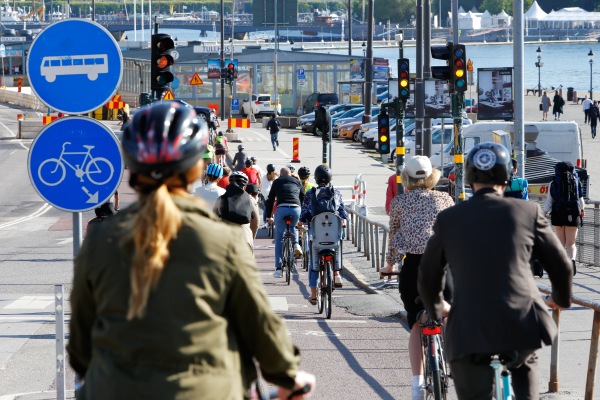
Where previously most people thought in terms of unprotected road users, over recent years the more positive term active mobility has become established, emphasising the benefits for health and the environment. This new mindset also represents a break from the norm of car use implicit in the old term. After all, it is clear what these road users are unprotected against: vehicles, of course.
According to the two VTI researchers most involved in active mobility – Anna Niska, director of the Swedish Cycling Research Centre at VTI, and Malin Henriksson, acting research director at the Mobility, Actors and Planning (MAP) unit – at the Swedish National Road and Transport Research Institute (VTI), active mobility is integral to the greater work of promoting the green transition of the transport sector.
“Yes, the transitional perspective is important. Electrification doesn’t solve everything; there are a lot of other things we need to do as well,” notes Niska.
Henriksson offers the example of the Avoid-Shift-Improve (ASI) approach to realising tomorrow’s fossil-free transportation: firstly, we need to avoid unnecessary travel; secondly, we need to shift to more climate-smart modes of transport and, finally, we need to improve the efficiency of technology such as electric vehicles.
“How do we go about this, what obstacles are there and what will the impact be on society and people? These are important questions and my unit is doing a lot of work on two of the three pillars: avoid and shift,” says Henriksson.
While a search of VTI’s database will show only a handful of projects related to active mobility, research in the field is concealed under a number of names. Research conducted at the Swedish Cycling Research Centre, which often concerns pedestrians as well, includes projects on road maintenance, skid prevention on cycle and pedestrian paths, road safety and how children and young people travel, to name only a few examples.
Projects at MAP include studies of how socioeconomic factors such as disability and low income affect cycling, planning conditions for ending car dependence, and shared transport solutions such as bicycles and electric scooters to supplement public transport.
While VTI generally conducts research on a broad front, there is a focus on identifying measures that can increase cycling and walking, and the likely impact of such measures. Projects are conducted both independently by VTI and in collaboration with partners in Sweden and abroad.
Another critical field of research is what drives people’s travel habits and values.
“The norm of car ownership is deeply entrenched. In the 1940s and ‘50s, the dream of owning a car was integral to the emergent welfare state. I think that, to a large extent, this is still the case. A nice car is a symbol of success. A driving licence and car ownership are part of becoming an adult,” says Henriksson.
“Everyone is aware of the benefits of exercise. But while we acknowledge that cycling is good for us, tax deductions are only possible for travel by car. And in planning, time is the be-all and end-all; we must always get there as quickly as possible. Less emphasis on saving time and more on other values would benefit walking and cycling,” says Niska.
“That said, there are some very interesting developments underway in places such as Paris, Gent and even Stockholm. Unfortunately, at national level in Sweden we are backsliding. One example is how we nudge 15- and 16-year-olds into car dependency with moped and tractor licences.”
So, what is the biggest obstacle to getting us to walk and cycle more? Is it values, infrastructure, economics, or something else?
“It’s all of those things. Even if we could reverse the norm, the [inadequate] infrastructure would still preclude everyone starting to cycle. And even if we had perfect infrastructure, norms would still preclude everyone starting to cycle. Its all interconnected and equally important,” says Henriksson.
The VTI researchers are agreed that we should be making it difficult to do the wrong thing and easy to do right.
“At present, making good choices requires strong personal conviction. Personally, I’m planning a trip to northern Sweden during the Easter holidays, and the entire family wants to travel climate-smart. However, that is more expensive, more complicated and more time-consuming than flying,” says Niska.
Perhaps the Government’s 2026 Year of Exercise campaign can change both attitudes and behaviour. A number of government agencies have presented initiatives, including investments in swimming lessons, new sports halls, improving conditions for people with disabilities to play sports, and a leisure activity card for children between the ages of 7 and 16.
The Swedish Transport Agency has also been given a government assignment to review regulations on cycle traffic, including an adequate distance for safely overtaking cyclists. This is an issue that has previously been addressed by VTI.
“It’s a good initiative that I hope will have an impact. It’s a shame that we so often talk about the transition as if it’s a sacrifice rather than something that benefits the climate, society and me as an individual,” says Niska.
“Yes, the transition is very much a matter of how people actually want to live: active, and with short distances between work, services and leisure activities. After all, not many people enjoy commuting long distances by car,” Henriksson points out.
So, what will the next steps be in active mobility research? For her part, Niska would like to see more interdisciplinary projects conducted at VTI. Henriksson is keen to study travel when the journey involves caring for somebody else: what competence is actually required to, for example, cycle with children?
Text: Mikael Sönne
Translation: CBG





Follow us: