

Reliable freight emissions reporting requires transparent, country-specific data. A new VTT report presents updated emission and fuel consumption factors for Finnish road freight, supporting companies, authorities and researchers as reporting requirements increasingly move towards life-cycle-based and comparable greenhouse gas information.
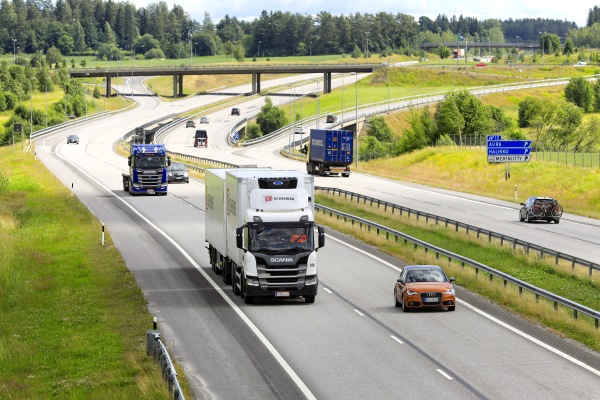
Why national data matter
Road freight emissions reporting is becoming more demanding. CountEmissionsEU, CSRD reporting and ISO 14083:2023 all increase the need for comparable greenhouse gas (GHG) data that cover not only vehicle operation, but also the production and distribution of the energy used in transport.
For Finnish operators, generic European values are not always sufficient. Fuel composition, particularly the shares of biofuel feedstocks, biofuel shares, operating conditions and vehicle combinations differ between countries. The TaKuPaaS project, funded by the Foundation of the Confederation of Finnish Industries and Employers (TT-Säätiö), and carried out by VTT, therefore set out to produce transparent and documented estimates for energy use, fuel consumption and GHG emission factors for road freight in Finnish conditions.
From fuels to vehicles
The project combined a review of existing emission calculation practices, eight expert interviews, extensive data collection and a workshop with transport-sector and emissions-calculation experts. The work produced GHG emission factors for the most common fuels used in Finnish road freight, covering well-to-tank, tank-to-wheel and total well-to-wheel emissions.
A key finding is that Finnish biofuel factors may differ substantially from generic European assumptions. In several cases, especially for biomethane, the well-to-wheel factors for fuels sold in Finland were lower than values based on broader European defaults. This illustrates why national data are important when emissions information is used for procurement, sustainability reporting or policy assessment.
The project also produced vehicle- and tonne-kilometre-based fuel consumption factors for diesel-powered N3 class trucks and vehicle combinations by weight class. These factors are intended for cases where primary fuel consumption data are unavailable. They take into account load factor and the share of empty running, making them more useful for practical calculations than more generalized consumption factors.
Practical next steps
The report identifies several remaining challenges. Some fuel distribution data are confidential, information on actual annual biofuel shares of sold fuels becomes available only after a delay of two years, and some calculation cases remain difficult to interpret. International databases also have limited ability to reflect national fuel compositions.
The TaKuPaaS results do not replace Finland’s earlier LIPASTO database, but they provide updated input for Finnish road freight emission calculations. They can support transport companies, freight buyers, public authorities, consultants and researchers in emissions reporting, impact assessment and the further development of transparent freight emissions data.
Based on:
Lauhkonen, A., & Vestinen, J. (2026). Tavaraliikenteen päästö- ja kulutustiedot yritysten ja yhteiskunnan päätöksenteon tueksi. VTT Technical Research Centre of Finland. VTT Tutkimusraportti No. VTT-R-00166-26. https://cris.vtt.fi/en/publications/tavaraliikenteen-p%C3%A4%C3%A4st%C3%B6-ja-kulutustiedot-yritysten-ja-yhteiskunna/
Contact

Arttu Lauhkonen
arttu.lauhkonen@vtt.fi
VTT Technical Research Centre of Finland Ltd.




Follow us: