

Bio-binders are carbon negative additives that can be mixed with bitumen and are a promising way to reduce carbon footprint in the road industry. Colas Iceland has delevoped products using bio-binders for a few years with good results, offering products with up to 25% lower carbon footprint.
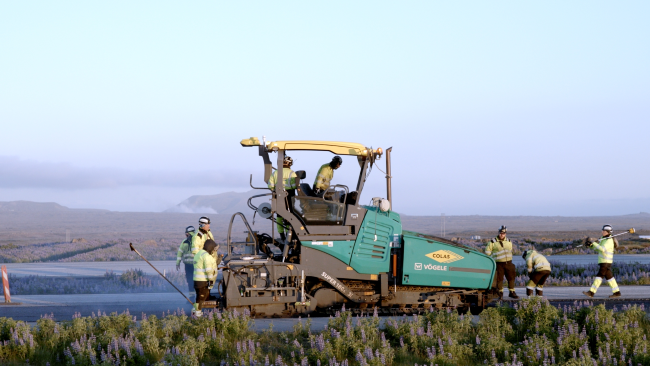
Colas Ísland is the largest asphalt producer in Iceland and strongly emphasizes environmental matters and innovation. One of the goals the company has worked towards over the last years is lowering the carbon footprint of asphalt. This has been done for example through increasing recycled asphalt pavement and the addition of bio-binders. In this context, the term bio-binders is used for products that have a negative carbon footprint and can be added to normal bitumen for asphalt production. Bio-binders are commonly byproducts from various industries, such as forestry or agriculture. During their lifetime, raw materials for bio-binders have sequestered more CO2 than is released during their production, making the product carbon negative. Bio-binders are not only carbon negative, their addition also lowers bitumen consumption. Bitumen is a very carbon intense product and a limited resource, adding to the benefit of using bio-binders. Bio-binders have a softening effect on the bitumen, which is favorable in Iceland, where relatively soft binder is generally used. Due to the climatic conditions in Iceland, main grades of bitumen used are 70/100 and 160/220.
Over the last few years, Colas Iceland has developed asphalt mixes using bio-binders, in collaboration with the Colas Group and with support from the Icelandic Road Authorities’ Research and Innovation fund. Asphalt mixes with two different bio-binders have been developed and tested by Colas. In both cases, preliminary development is done at laboratory scale, before trial production and paving. The goal was to make grade 70/100 bitumen by mixing bio-binder to grade 40/60 bitumen. The grade was obtained with 9% of bio-binder A in one case and 3% bio-binder B in the second case. The bio-binders have different viscosities and therefore need to be used in different quantities. Both mixes were AC16, designed for high traffic roads according to quality requirements of the Icelandic Road Authorities.
Trial production was done in late June 2024. To get the best comparison, three different mixes of asphalt were produced on the trial day. The three mixes were: AC16 with normal 70/100 bitumen, AC16 with bio-binder A and AC16 with bio-binder B. The three mixes were paved consecutively on a straight, high traffic road. Samples were taken from all three mixes and of the bitumen blends with bio-binders. Wheel tracking (EN 12697-22), water sensitivity (EN 12697-12 and -23) and resistance to studded tires according to the Nordic Prall test (EN 12697-16: Method A) were performed in an external lab. The bitumen blends were tested for standard properties such as penetration (EN 1426), softening point (EN 1427), viscosity (EN 12595), RTFOT (EN 12607-3) and more in an external lab. In addition, samples of both the asphalt and binder were checked according to normal production quality control in Colas Iceland‘s lab. In all cases, the results fulfill quality requirements for high traffic roads in Iceland. Following the paving, skid resistance was measured and turned out to be uniform across all three sections. Finally, wheel track formation and general conditions of the trial sections will be monitored for three years.
The usage of bio-binders in asphalt is a promising way to reduce carbon footprint in the road industry. As a result from the development from previous years, Colas Iceland can now offer customers asphalt containing bio-binder, with carbon footprint up to 25% lower than standard asphalt, without lowering quality.
Authors:
Björk Úlfarsdóttir and Sigurrós Arnardóttir Colas Ísland, Iceland
Fact box
Article based on Lífbindiefni í malbik (Bio-binders in Asphalt:): https://www.vegagerdin.is/media/2025/07/nr_1800_974_lifbindiefni-i-malbik-2024.pdf [Icelandic]




Follow us: