

How do autonomous delivery robots interact with people in real-world traffic environments and what rules are needed to control the robots’ progress? And how should they be used and combined with other modes of transport to create real benefits? These are the main research questions in two projects in which the Swedish National Road and Transport Research Institute (VTI) is playing an important role.
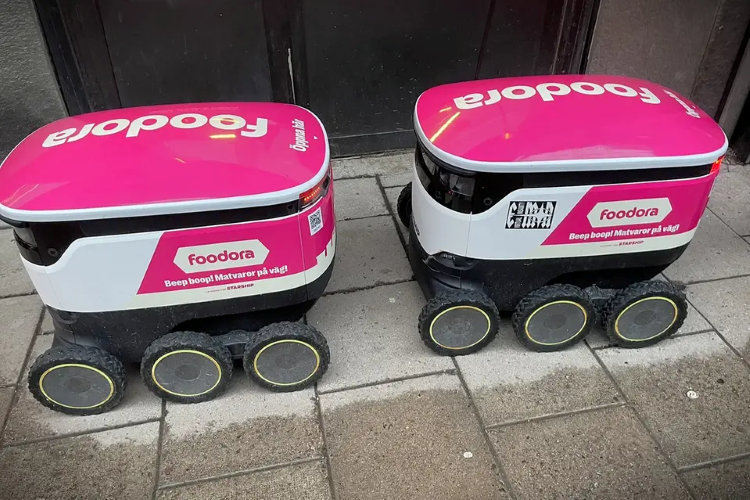
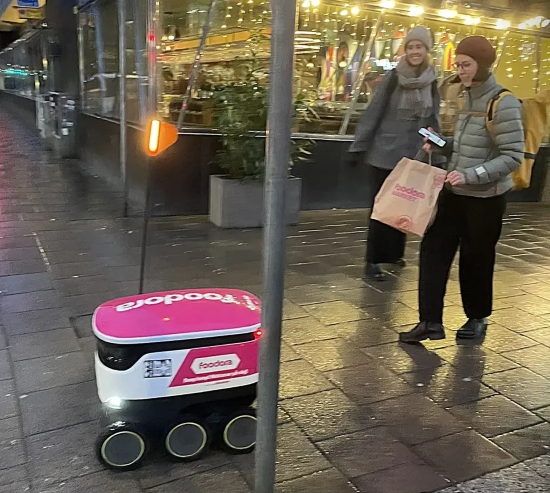
Foodora has been delivering groceries in Södermalm, Solna and Sundbyberg since spring 2025 using small autonomous robots developed by Starship Technologies. In the project When delivery robots enter public spaces: A longitudinal study of Starship robots in Stockholm, led by Linköping University, researchers have been following the robots to film their behaviour in traffic, as well as how we humans react to these small vehicles. A total of 15 robots are included in the project, five of them in the City of Stockholm.
Thus far, experiences have been positive. The City of Stockholm has received barely any complaints; on the contrary, may people seem to find the robots cute and a fun addition to the urban landscape. The only problem reported is slight congestion outside Foodora’s Södermalm warehouse, where the robots park.
“Most, if not all, people are surprisingly positive and helpful when it comes to this type of robot. The manufacturers often try to give them a slightly sweet appearance, like R2-D2, something that can make us humans more positively disposed to them,” says Daniel Rudmark, who is working on the project.
“That said, the pavements are already congested and suddenly here’s a new actor, a brand-new contraption that’s also taking up space. There’s every reason to wonder how it will go and what benefit it can create for the transport system.”
VTI’s role in the project is about just that: policy and regulatory development. Based on the videos and subsequent analysis performed by Linköping University, the researchers will be proposing rules on how autonomous delivery robots should be allowed to use pavements and to park, matters that need to be considered before any future large-scale rollout of similar robots.
At present, in effect there are no rules aside from classifying the robots in Class II along with vehicles such as snowmobiles and quad bikes.
In the second project, HelsingBotica, researchers are studying how delivery robots can be integrated into a transport system and combined with other vehicles to have the greatest benefit. The project ends in May and, although the final report is not quite ready, thus far the results have been highly promising.
Combining autonomous robots with delivery vans significantly reduces costs, energy consumption, and emissions. The trial involves vans dropping off goods at a transhipment station where the robots take over for the final leg to the customer’s door.
“As a service, its a kind of hybrid of traditional home delivery and a parcel locker,” says Rudmark.
In the final phase of the project a survey will be conducted of Helsingborg residents who have used the service and those who have not. The project is a collaboration with the City of Helsingborg, pharmacy chain Apotea, Best Transport and Engage Studios.
Translation: CBG
Contact
- Daniel Rudmark
Senior Research Leader
daniel.rudmark@vti.se





Follow us: