
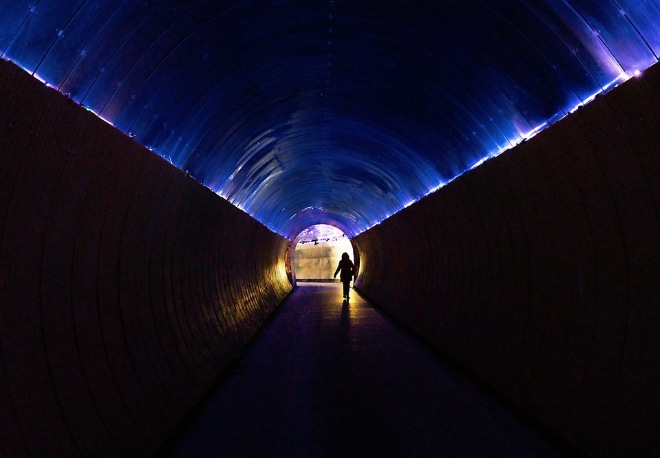
The Swedish National Road and Transport Research Institute (VTI) is studying how pedestrian and cycle tunnels should be designed for optimal perceived safety. With the aid of the institute’s VR equipment, participants in the study were asked to evaluate and describe their perceptions of virtual tunnel environments.
“We wouldn’t venture to say anything about the results as yet. The study will be presented in a VTI report to be published in May, only then will we go public with our conclusions,” says Sara Nygårdhs, senior researcher at VTI, who managed the project in collaboration with colleagues senior research engineer Florian Fischer, analyst Jonas Ihlström, research engineer Linus Hilding, engineer Pelle Wredenborg and research assistant Per Henriksson.
A total of 28 people took part in the study, divided into the age groups 18–29 and 65+ and one group of four wheelchair users. All groups were gender balanced. This selection was intended to provide a range of participants with varying experiences and circumstances, rather than to draw conclusions for each group. Pedestrian and cycle tunnels must of course work for everyone by design. The necessary ethical approval was obtained prior to recruitment.
The project commenced with half-hour interviews followed by VR simulations. Each participant was asked to evaluate a total of ten different scenarios in five different tunnels in daylight and after dark, although always with lighting inside the tunnel. The simulations covered the environment outside the tunnel, at the entrance and 10 metres into the tunnel.
The test subjects were then asked six questions to evaluate their perceptions of the simulated environments. This included how unsafe they felt and how unpleasant they found the experience, whether the tunnels felt confined or airy, and the role of lighting in and around the tunnels. They were also asked to evaluate the height and width of the tunnels in relation to perceived safety.
One factor that was not tested in the VR study but that came up during the interviews was how the presence of other people affected the experience in various ways, whether positive or negative.
“We left it to the study participants to decide what constitutes safety. Some thought about gravel, while others have heard that there might be crime. It varies somewhat,” says Nygårdhs.
The report will be used when the Swedish Transport Administration revises its recommendations on the design of roads and streets (VGU), so that social sustainability can be addressed by increasing perceived safety in pedestrian and cycle tunnels.
VTI also has its own VR bicycle environment simulator. The focus of this project has been on pedestrians, but the bicycle simulator will allow us to conduct equivalent studies of cyclists in future projects.
Contact
- Sara Nygårdhs
- Senior researcher
sara.nygardhs@vti.se





Follow us: